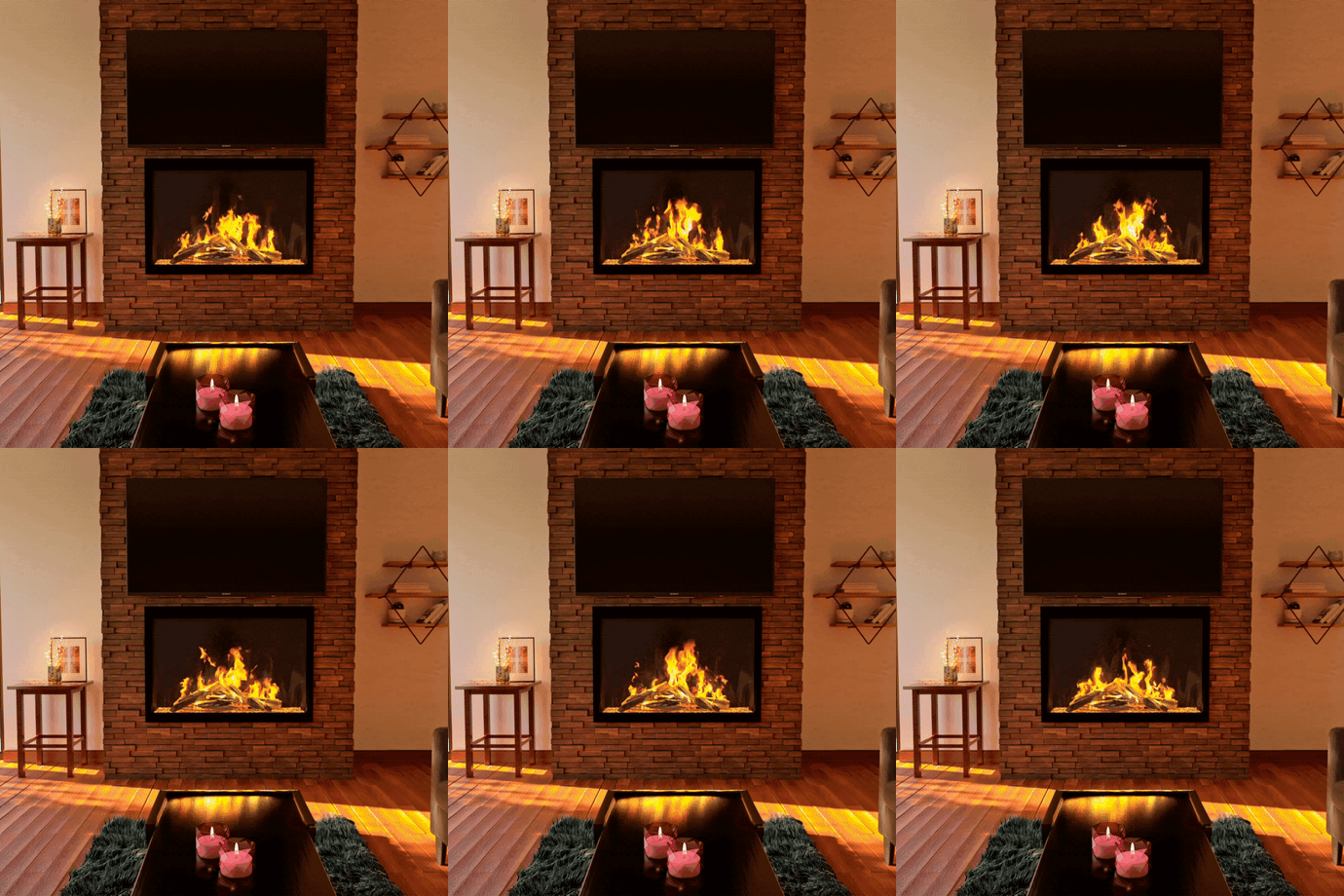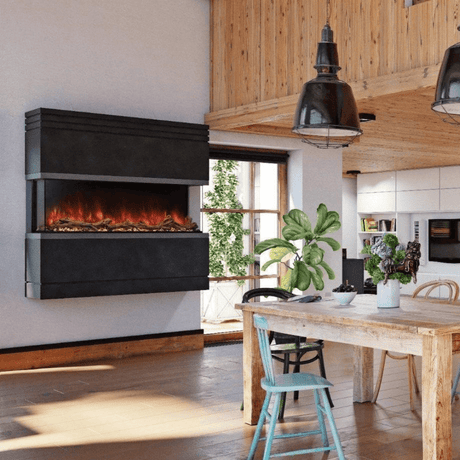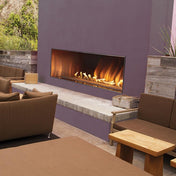

A fireplace in a kitchen sounds like a contradiction until you have stood in one. The kitchen is already where people gather, and a fire gives them a reason to stay past the cooking instead of drifting into the next room. It also does something no island or backsplash can: it makes a working room feel like a living one.
It is more common now than it used to be for three specific reasons, and all three are recent.
- Vent-free changed where a fireplace can go. No chimney and no flue means the fireplace is no longer tied to an exterior wall or a structural chase, so it can sit wherever the room actually wants it.
- Installation became a renovation job rather than a build. A framed opening and a circuit is work the trades already on site can do, which is a different order of cost and disruption from opening a roof.
- Electric fireplaces run the flame with the heat off. This is the one that matters most in a kitchen. A kitchen already gains heat from the oven and the cooktop, and most of the year you do not want more of it. You want the light and the movement. Electric lets you have the fire and decline the warmth, and water vapor never produces any in the first place.
Below are the placements that actually work, and the practical questions each one raises. Everything shown is from our electric fireplaces and indoor gas fireplaces ranges. If you are shopping by look rather than by fuel, most of it also sits in modern fireplaces.
Start Here: Why Most Kitchen Fireplaces Are Electric
A kitchen is the hardest room in the house to vent a fire in, and that single fact drives most of these decisions.

Kitchens already have a powerful exhaust in them. A range hood pulls a large volume of air out of the room, and in a well-sealed house that can lower the pressure indoors. Any appliance that draws its combustion air from the room, which is what a vent-free gas fireplace does, is working in the same air the hood is removing. It is not a reason to rule gas out, but it is a question for whoever sizes the installation, and it is why makeup air comes up in kitchen renovations at all.
An electric fireplace sidesteps the whole discussion. There is no combustion, nothing to vent, no clearance to a flue, and no interaction with the hood. It needs a circuit and a framed opening. That is why nearly every kitchen fireplace we sell is electric, and why the rest of this guide leans that way.
On the heat, check that it is a genuinely separate control. Running flame without heat is the setting a kitchen lives in, so confirm the model does it from the remote or the app rather than only from a switch behind the unit, which is unreachable once it is built in. Where the heater does get used, treat it as supplemental: most are rated for a few hundred square feet, not for warming an open-plan floor.
Put It Between the Kitchen and the Living Room

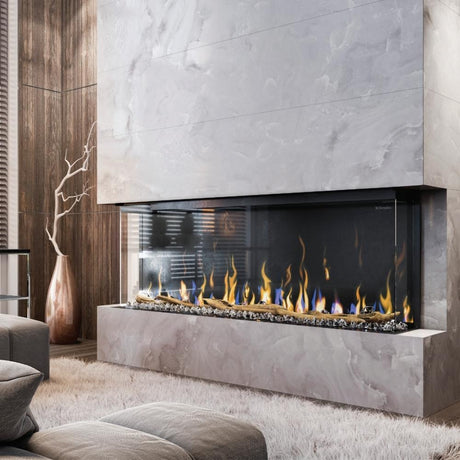
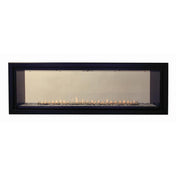
This is the placement that changes a floor plan rather than decorating it. A see-through fireplace sits in the partition wall between the kitchen and the room next to it, so it faces both ways. The cook is not shut behind a wall, the seating side gets a real focal point, and the two spaces stay separate without either feeling closed off.
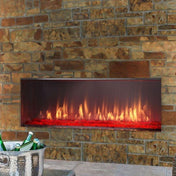
It suits the layout most people already have, since a kitchen usually backs onto a dining or family room. On the gas side, the Monessen Lo-Rider See-Through is a clean-faced ventless firebox designed to be finished into a wall. More options in see-through fireplaces.
Wrap the End of an Island or a Peninsula

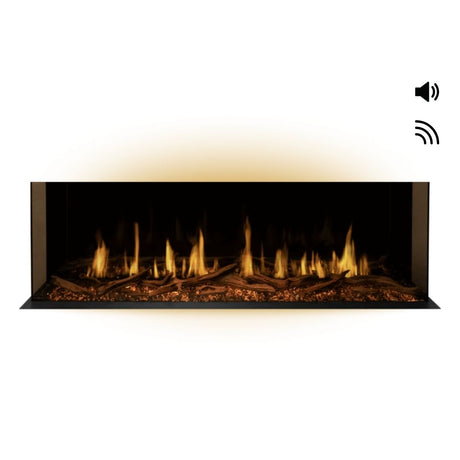
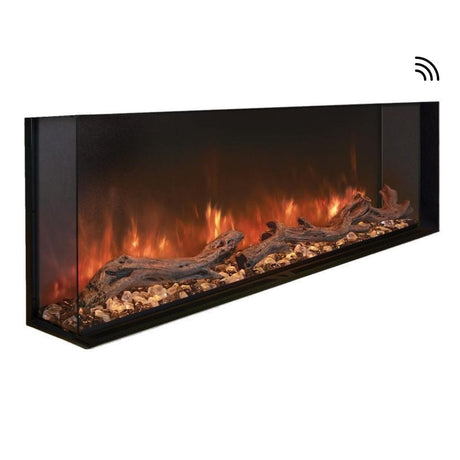
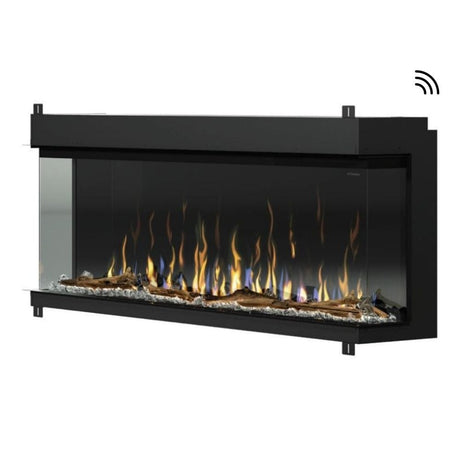
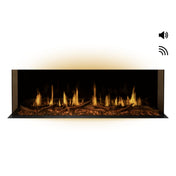
A three-sided fireplace shows flame from the front and both sides, which is exactly what you want at the end of an island, a peninsula, or a half-wall that stops partway across a room. From the kitchen you see one face; from the seating you see two.
The Modern Flames Orion Multi is the most realistic of these, because it plays a recording of a real fire rather than synthesizing one with light. The Dimplex Ignite XL Bold links multiple units into one continuous run, which is useful when the island is long. For a wall-mounted version that needs no framing at all, the Touchstone Chesmont hangs on the surface. The full range is in 3-sided electric fireplaces.
Going into the island itself? Use electric. An island is cabinetry, which means it is combustible on every side of the opening, and it is usually full of drawers, a dishwasher or a wine fridge immediately behind the face. An electric firebox produces no combustion, so it is the category designed to be surrounded by exactly that. Still check two things: the clearance the manufacturer specifies to countertop overhangs, and how much depth is genuinely free behind the opening once the cabinet run is accounted for.
If you want a real flame in an island, the clearances become the whole decision. Ethanol and gas both put actual combustion inside a box made of wood and laminate, and each manufacturer specifies minimum distances to combustible material on every face, above the opening, and often to the underside of a countertop. Get those figures before the cabinetmaker draws anything, have the installer confirm them against the built joinery rather than the plan, and be prepared for the answer to be that the island cannot take it. A wall at the end of the island almost always can.
Run It Long and Low on the Wall

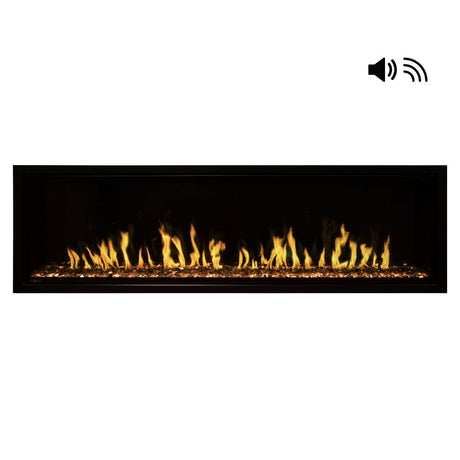
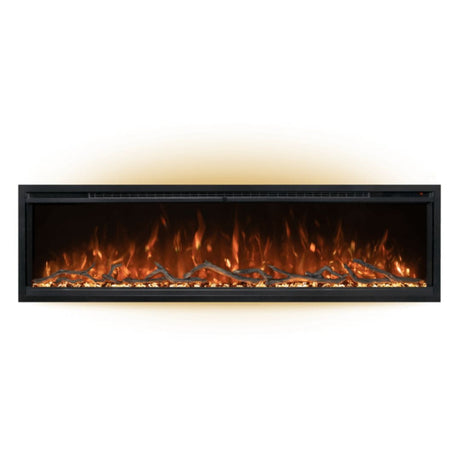
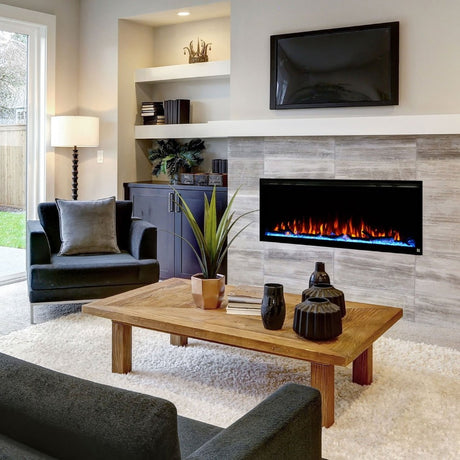
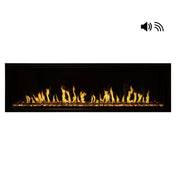
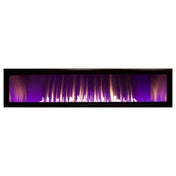
A linear fireplace is a wide, shallow ribbon of flame, and it works in a kitchen for the same reason it works anywhere else: it reads as architecture rather than as an appliance. On a kitchen wall it sits comfortably under cabinets, above a bench, or in the run of wall between the end of the cabinetry and the doorway.
The Modern Flames Landscape Pro Slim recesses into a standard 2x6 wall and comes in a wide range of widths, and the Dynasty Cascade is a good-value alternative in the same shape. Browse linear electric fireplaces for the rest.
Make Room for a Sitting Area at the End of the Kitchen

Plenty of kitchens have an awkward stretch at one end: too small for a dining table, too big to leave empty. A fireplace with two chairs turns that into the most used corner of the house, and it is the single best answer to the leftover-space problem in an open plan.
What matters here is eye level. A fireplace meant to be looked at while seated should sit lower than one meant to be seen across a room, so measure from the chair rather than from the floor. A recessed unit like the Touchstone Sideline Elite Pro can be set at whatever height the seating wants, since it is framed in rather than hung at a fixed point. It also comes in more widths than almost anything else we carry, from a size that suits a narrow alcove up to one that fills a feature wall, so the fireplace can be scaled to the gap you are filling rather than the gap being designed around the fireplace.
Small Kitchen? Go Slim and Recessed

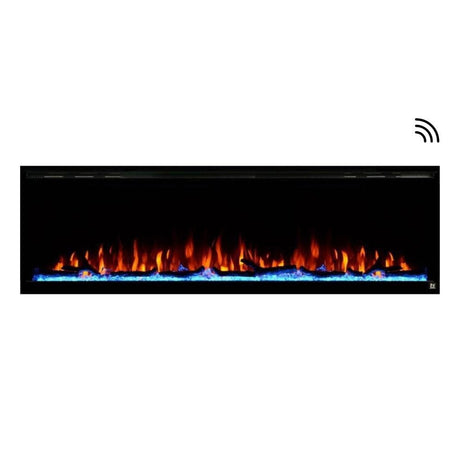
In a small kitchen the fireplace has to give back more than it takes, and the way to do that is to recess it so it takes no floor space and projects nothing into the walkway. A slim built-in disappears into the wall and reads as a lit panel rather than as furniture.
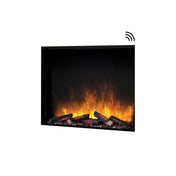
In a small kitchen the constraint is almost always depth, not width. Interior partitions are usually 2x4, which gives you about 3.5 inches to work with, and most fireboxes need more than that. Rather than checking models one at a time, start from recessed electric fireplaces for a 2x4 wall, which is filtered to the units that genuinely fit. The Modern Flames Spectrum Slimline and the Touchstone Fury are the two we point people to most, both under five inches deep.
If you have a 2x6 wall, which gives roughly 5.5 inches, the field opens up considerably and the units in small electric fireplaces come into range. Measure the wall before you shop either way, because this is the specification that rules models out fastest.
Drop One Into a Hearth You Already Have
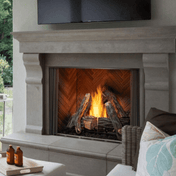
Older houses sometimes have a masonry fireplace in or beside the kitchen that has not been lit in decades, usually because the chimney would need work. You do not have to touch the flue to get it back. There are three levels of effort here, and they are worth knowing apart before you shop.
Easiest: A Plug-In Log Set
An electric log set is the least invasive option there is. It sits inside the existing firebox, plugs into a nearby outlet, and needs no framing, no trim and no electrician. If the opening is sound and you simply want the hearth to look alive again, this is a same-afternoon job.
The Dimplex Revillusion log set is the one to look at first, and the Napoleon Woodland is the alternative, both in a spread of sizes so you can match the width of the opening rather than the other way round.
Middle Ground: An Electric Insert
An insert fills the opening properly rather than sitting inside it, so you get a finished face and a lot more flame. It still slides into the existing masonry, but it wants a trim kit and, depending on the model, a hardwired connection.
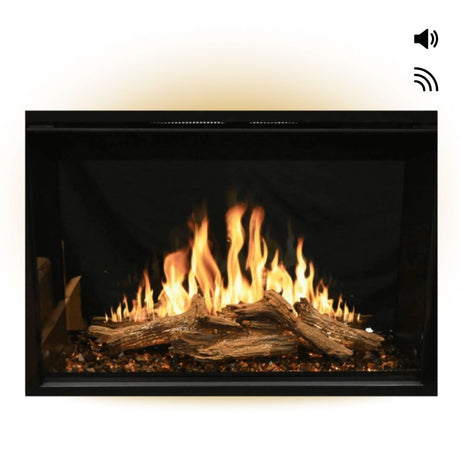
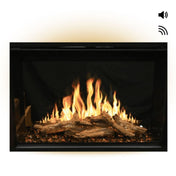
The Modern Flames Redstone is the one we sell most of, in a spread of sizes to suit different openings. The Dynasty Presto is only eight inches deep, which is the one to reach for when the original firebox is shallow. For a traditional look with logs rather than a linear face, the Dimplex Revillusion firebox is built to be seen without glass across the front.
Best Result: Modern Flames Orion Traditional
If the fireplace is going to be the thing people look at in the room, this is the one. The Orion Traditional is our best-selling electric fireplace, and the reason is the flame: it plays a recording of an actual fire on a screen rather than synthesizing one out of light, which is obvious at the distance people sit from a kitchen hearth.
It retrofits into an existing opening as well as building in from scratch, so it belongs in this section even though it costs more than an insert. See the Orion Traditional, and the rest of the options in electric fireplace inserts.
Measure the opening before you shop, not after. Masonry openings are rarely square and almost never a standard size, so take the width at the front and the back, the height at both sides, and the depth at the shallowest point.
Water Vapor, If You Want Flame Without Heat
A kitchen is often warm enough already, and a vapor fireplace is the answer to that. It produces its flame from ultrasonic mist lit from below, so there is no combustion and no heating element at all. It looks like fire from a few feet away, and because the mist is water it adds a little humidity to the room rather than drying it. An electric fireplace can run its flame with the heater switched off; a vapor unit has no heater to switch off in the first place.
The Dimplex Opti-Myst Aura is three-sided, which suits the same island and peninsula positions as above.
You Do Not Have to Keep Refilling It
The usual objection to vapor is topping up the water, and it is a fair one in a kitchen where the fireplace may run daily. Several models solve it outright by connecting to a water line, so the unit fills itself and runs continuously without anyone thinking about it.
The Dimplex Opti-Myst 500 cassette offers a plumbing connection kit for exactly this, and the Litedeer Mercury runs about twenty hours on its internal reservoir or indefinitely once plumbed in. A kitchen is the easiest room in the house to do this in, because there is already a water supply behind the cabinetry.
Decide this before the wall closes. Running a small supply line to the fireplace is trivial while the wall is open and awkward afterwards, so it is worth settling even if you plan to fill it by hand at first. Browse the full range in water vapor fireplaces and inserts.
The Practical Checks Before You Pick a Spot

- Clearance to combustibles. Kitchens are full of cabinetry, and every fireplace specifies a minimum distance to anything that can burn. Check it against the cabinet run, not just the wall.
- The circuit. Most built-in electric fireplaces want a dedicated circuit, and the larger ones hardwire. A kitchen is already one of the most heavily loaded rooms in the house, so this is a conversation with an electrician early rather than late.
- Depth of wall. A recessed unit needs the wall to be deeper than the firebox. A 2x4 wall gives about 3.5 inches and a 2x6 gives about 5.5, which rules out a lot of units before you start.
- Grease and steam. Keep the fireplace out of the immediate cooking zone. It is a finish surface, and the area beside a range collects everything the hood does not catch.
- What you will see from the seats. Stand where people will actually sit before you commit to a height and a wall.
If you need help narrowing it down, reach out to our team of fireplace professionals. Call or text 866-713-2399, or email support@modernblaze.com. If you know your wall depth and how wide a space you are filling, we can usually narrow it down to two models on the first call.
If you would rather browse right now, these are good places to start: