

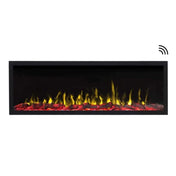
A water vapor fireplace makes its flame out of mist and light. Water sits in a reservoir, an ultrasonic transducer vibrates it into a fine fog, and LEDs light the fog from below. It rises and curls the way real fire does, and because nothing is burning, you can put your hand straight through it.
This guide covers what the category is, how to tell a good one from a cheap one, and what installing it actually involves. It ends with which brands to look at once you know what you want. If you already know the category and want models compared, go straight to eight models compared side by side.
Anastasia walks through the whole category on the Modern Blaze Show, including the questions customers ask most.
What makes this category different
Nothing burns, so there is no flue, no gas line and no combustion air to plan for. That is the whole appeal, and it is why these turn up in apartments, restaurants and rooms where a real fire was never an option.
The flame is also genuinely three-dimensional. A screen shows a picture of fire on a flat surface. Mist takes up space, so the flame looks different from every angle and reads as real at close range. That is the one thing an electric fireplace cannot copy.
And it is cool. You can pass your hand through the flame, which is why designers specify them in hotels, malls and restaurants where an open flame would be a liability.
How a water vapor fireplace works

A transducer sits under a shallow reservoir and vibrates thousands of times a second. That breaks the water into a cool fog. LEDs underneath light it, and the fog rises through the opening as a flame.
Here is the part almost nobody explains. What lifts the vapor is a heater running the length of the opening, creating an updraft. On a bare cassette that heater exists only to make the flame rise, not to warm your room. Dimplex is explicit about this: a cassette is flame visual only, and any warmth is a separate function on other models.
That has a practical consequence. Every vapor product needs an air intake so air can reach the bottom of the unit and feed that updraft. Skip it and the flame looks thin and unconvincing. Dimplex sells an intake grille for exactly this reason, and it is the detail most likely to spoil a custom build.
This episode takes a cassette apart and shows each part doing its job.
What every water vapor fireplace has
Whatever you buy, all of these are true:
- No venting. No flue, no chimney, no gas.
- A cool flame you can touch. There is no combustion anywhere in the unit.
- A water reservoir and a transducer. The transducer is a wear part on every model.
- An electrical connection. Either a standard outlet or a hardwire, depending on size.
- An air intake requirement, which the installer has to provide on built-in models.
- Remote control, with app control on most current models.
- Regular cleaning. Minerals in the water leave deposits on the glass and in the reservoir.
- Indoor use only. These are not rated for an open patio, unlike many electric fireplaces.
Does it give off heat?
The flame itself gives off none. The mist is cool, which is the point.
Heat, where a model has it, comes from a separate heater behind the flame, and it switches independently. You can run the flame with no heat in July. Most of the models we carry now include one, which was not true a few years ago. The bare cassettes and the pure-ambiance models are the exceptions, and on Opti-Myst cassettes a heater can be added as an accessory.
Output runs from about 4,000 up to roughly 8,000 BTU. The higher figure needs a 240V hardwired circuit; on a standard 120V outlet you are in the 4,000 range. Treat it as supplemental heat for one room rather than a heating system. If warmth matters, start with the models that have heaters rather than assuming one does.
Will it make the room damp?
This is the question we get more than any other, and the answer is no.
Dimplex describes the moisture a vapor fireplace adds as the equivalent of a few people in a room talking. You will not perceive it, and it does not cause mold. In winter, when heating dries the air out, the small rise is usually welcome.
Two real caveats. On an enclosed unit you may see condensation on the glass when you first switch it on, in the same way a direct vent gas fireplace fogs at start-up. Leave it running and it clears. And when you set the logs or media, keep them off the glass. Vapor collects against anything hard up against the front and condenses there.
What it costs to run
Less than people expect, because the flame is mist and LEDs rather than a heating element.
Running the flame alone draws around 230 watts on a cassette, roughly what a couple of light bulbs use. A freestanding stove can drop to about 135 watts on flame only. Switch the heater on and you draw what any electric heater draws, so the flame is cheap and the heat is not.
On purchase price, these sit close to the most advanced virtual electric fireplaces. Against gas you save on both the unit and the installation, because there is no gas line and no vent to run.
Installation types, and what each one needs

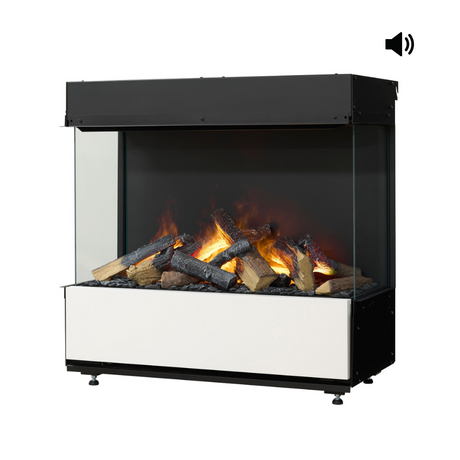
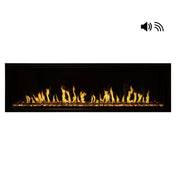
Cassettes are bare units that drop into a surround you or your builder design. They give the most freedom, including a fire open on all four sides, and several join end to end for a long linear run. They need a built surround, an air intake and usually a water line.

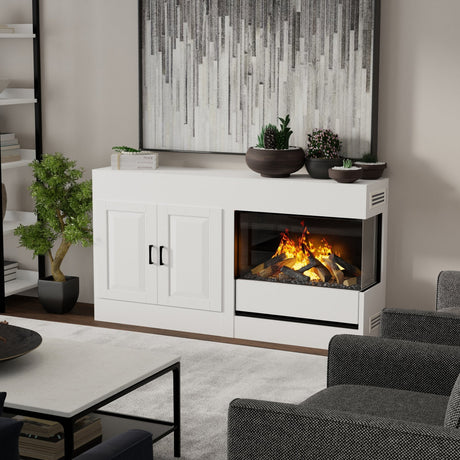
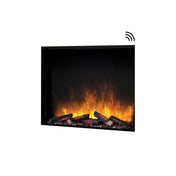
Built-in fireboxes arrive finished, with glass and a housing. You frame an opening and slide them in. Less freedom than a cassette, far less building work, and the glass protects the flame from drafts so it looks more consistent.

Inserts go into a masonry fireplace you already have. This is the least invasive route, and it usually refills from a drawer at the front rather than a water line.

Freestanding stoves need no opening and no wall work at all. Set one down and plug it in. This is the only version with no construction whatsoever.

Browse the full range of water vapor fireplaces and inserts to see which format suits your room.
Plumbed or refilled, the decision that actually matters
Every one of these needs water, and there are only two ways it gets there. This is what product pages skip, and it matters more than the flame does.
Refilled units hold water in a tank or a pull-out drawer. A 20-inch cassette section runs eight to ten hours per bottle. On models designed around refilling, it is easy and the unit keeps running.
Plumbed units take a quarter-inch water line and run continuously. Set it and forget it. That is the better experience, and on a wide linear unit it is close to mandatory, because hand-filling one can mean removing the front glass every evening.
If you are building a wide vapor fireplace into a wall, run the line while the wall is open. It is a small job at framing stage and close to impossible afterward.
Do you need a professional to install it?
It depends entirely on which format you chose.
No, for a freestanding stove or a plug-in insert. Set it down, plug it into a standard outlet, add water.
Yes, for anything hardwired. Larger and built-in models wire directly, and the higher-output heaters need a dedicated 240V circuit. That is an electrician, not a weekend.
Yes, for anything plumbed. Running a water line to a fireplace is straightforward plumbing, but it has to happen before the wall closes.
And a carpenter for a cassette, because you are building the fireplace around it. The work is joinery rather than combustion, so it is simpler than a gas build, but it is still construction.
Whatever the format, confirm you can still reach the water reservoir once the wall is finished. That is the mistake that is expensive to undo. Our Opti-Myst installation guide covers each stage with video.
Which specifications matter, and which do not
Matter:
- How the water gets in. Plumbed or refilled, covered above. Nothing else affects daily life as much.
- Whether it has a heater, and at what voltage. This decides whether you get warmth or only the look.
- Width, and whether units join. A long fire is either one wide unit or several cassettes linked.
- Viewing configuration. Single-sided, see-through, corner or open on all sides. Decide this before the wall is framed.
- Air intake provision. Easy to overlook and it visibly changes how good the flame looks.
Do not matter as much as the listing implies:
- The number of flame colors. Every current RGB model offers plenty. Nobody has ever wished for more.
- Precise BTU figures. The meaningful question is only whether it is a 120V or a 240V heater.
- Crackling sound. Pleasant, and never the reason to choose one model over another.
What a premium model buys you
Spending more in this category buys four things, roughly in this order.
A plumbed water connection, so you never refill. A real heater on its own circuit, so it warms as well as looks good. Width in a single unit, which is cleaner than joining cassettes. And a finished enclosure with glass, which shields the flame from room drafts so it stays consistent. A bare cassette is at the mercy of the air around it.
App control and color used to be premium features and are now close to standard. Dimplex is phasing out its single-color cassettes entirely.
Good, better, best
Because the transducer is a consumable, you are choosing a company you will source a part from in a few years, not just a fireplace.
| Tier | Brand | What you are paying for | Start here | |
|---|---|---|---|---|
 |
Good | Litedeer | Newer to the category and priced accordingly. The widest single cassette here, multicolor flame, app control, and direct plumbing at no extra cost. | Litedeer Mercury |
 |
Better | GlammFire and Malm | Both wrap their own enclosure around Opti-Myst technology, so the part that wears is the one Dimplex supports. You are paying for design: GlammFire for architectural linear units, Malm for a sculptural piece. | Malm Zircon · GlammFire Prestige |
 |
Best | Dimplex | They developed the technology and patented it. The widest range, from bare cassettes to freestanding stoves, and the longest parts support of anyone. | Dimplex Opti-Myst |
The Opti-Myst buyer's guide goes through the Dimplex range model by model.
Living with one
Use clean tap water on the Dimplex models, or filtered water in a hard water area, because scale is what shortens the life of the parts. Some brands ask for distilled water, so check the manual for yours. Never use well water.
Wipe the mineral film. Deposits build on the glass and in the reservoir, and how fast depends on your water. Clean the unit monthly at minimum.
Replace the transducer about once a year. Dimplex compares it to brake pads: a consumable you swap when it stops working, not a fault. Every cassette ships with a spare, and it is an inexpensive stocked part. Hard water shortens its life, which is the real reason to care about water quality.
Going away for more than two weeks? Drain it and dry every component that holds water.
One reassurance. Dimplex builds antimicrobial protection through the water path on Optimyst models, tested to ISO 22196. The water in the reservoir is not the health concern people assume it is.
Is a water vapor fireplace right for you?
Yes, if you want the most convincing flame available without combustion, you cannot vent, or you are designing something a vented appliance could never do. It is also the obvious answer for a commercial room where an open flame is a liability.
Probably not, if you need real heat for a large space, or if nobody in the house will clean it. These reward a little attention and suffer without it. There is no shame in preferring an electric fireplace that asks nothing of you at all.
If you are cross-shopping, this is how the four ventless-or-not options actually compare.
| Type | Flame | Heat | Venting | Install | Ongoing |
|---|---|---|---|---|---|
| Water vapor | Mist and light, three-dimensional | About 4,000 to 8,000 BTU | None | Power, and a water line if plumbed | Refill or plumb, clean monthly, replace the transducer |
| Electric | LED effect or a video flame on a screen | About 5,100 BTU on a standard outlet | None | Plug in, or hardwire for the bigger heaters | Nothing |
| Gas | Real fire | 9,500 up to 300,000 BTU | Vented or vent-free | Gas line, and a vent on most models | Annual service |
| Ethanol | Real fire | About 4,000 to 20,400 BTU | None | Little or none | Buy fuel, refill by hand |
Read across the water vapor row and the trade is clear. You give up serious heat and take on a little maintenance. What you get back is a flame with real depth, in a room you could never vent.
Electric is the closest competitor, and it is worth being precise about why. The newest virtual electric fireplaces play a recording of a real fire on a screen, and at a glance they genuinely rival this. What they cannot do is depth. A screen is flat, so the flame stops working as you move past it, while mist occupies real space and reads correctly from any angle. If you are weighing the two, our guides to the most realistic electric fireplace inserts and to virtual versus LED flame technology cover that side. The wider electric fireplace guide covers the category as a whole.
Where to go next
Once you know the format and whether you are plumbing it, read our comparison of eight models. Every specification there was checked against the manufacturer manual. For real rooms rather than renderings, see these creative installation ideas.
Still not sure which suits your space? Talk to our team and we will work through it with you.






8 comments
Hi, Karen.
You can check the products in this collection: https://bit.ly/3Wu3c8L
Each of them has reviews toward the bottom of the page.
We currently have 3 water vapor fireplace models, and the Dimplex Opti-myst units are our most reviewed if you want to read what our customers think about them!
If you have more questions, please don’t hesitate to email us at support@modernblaze.com.
Hi,
We have been to two fireplace stores in Massachusetts. We were able to see one working at the first place. However, at the second visit it wasn’t working. At the other place they steered us away from theirs and said that they were only problematic. We would plumb one if we put it in. It would have picture windows above it in a contemporary setting.
I really don’t like the look of the flames on other electric options and because of the windows above a gas fireplace just doesn’t work because of venting issues. Could I talk to some satisfied clients?
Karen
Hi, Owin!
This article can be helpful: https://modernblaze.com/blogs/shopping-guides/dimplex-opti-myst-water-vapor-fireplaces-buyers-guide
It has a section towards the end about condensation, humidity, and other issues about water vapor fireplaces.
If you have more questions, please don’t hesitate to call us or email us at support@modernblaze.com!
Hi, Abby!
I understand that you’re looking into dehumidifiers. If humidity is your main concern, then a water vapor fireplace could be the opposite of what you need.
This article may have more specific information for you: https://modernblaze.com/blogs/shopping-guides/dimplex-opti-myst-water-vapor-fireplaces-buyers-guide. It says that vapor fireplaces can actually increase humidity but only by a small amount.
There is also a portion towards the end recommending against installing vapor fireplaces in small rooms/spaces due to condensation.
If you’re still open to the idea of an electric fireplace though, we have a lot of options for you: https://modernblaze.com/collections/modern-ventless-electric-fireplaces
Please don’t hesitate to give us a call or reach out to us at support@modernblaze.com!
What happens to water vapour? Are there issues with condensation etc.?
I just found you folks doing a little research and I have a question. We are building an extremely tight house and we will need air exchangers and installing a dehumidifier due to our wet climate. So the question is What happens to the mist, and the moisture it is putting into the house. Does the unit push the humidity out into the house or does it recondense into the box, possibly creating a mold situation or what. Guess I am not grasping that and with people with compromised immune systems it is a constant concern. Thanks for your response
Yes!! We were so excited when Bar Rescue reached out and wanted to feature our water vapor fireplace on their show! Jon Taffer absolutely loved the Opti-myst cassette they got from us and they even ordered more for the next season! :)
Saw this on John Taffy’s Bar Rescue show and immediately googled it! Now I want to learn more!!