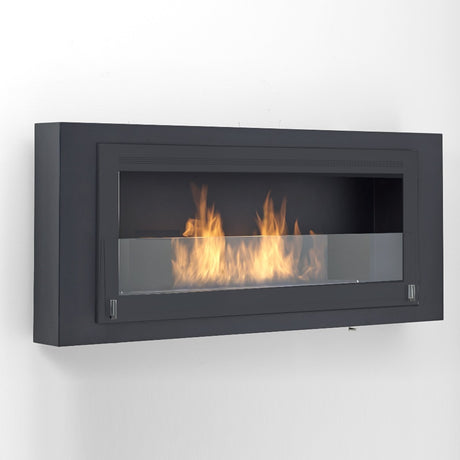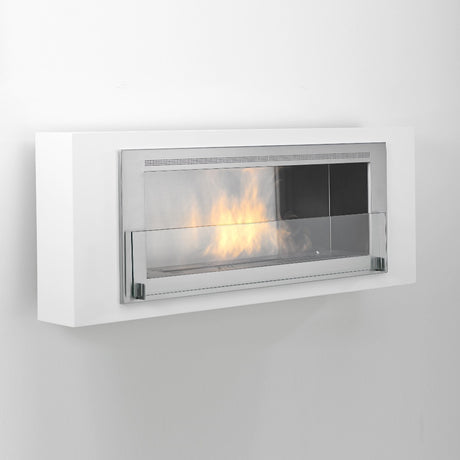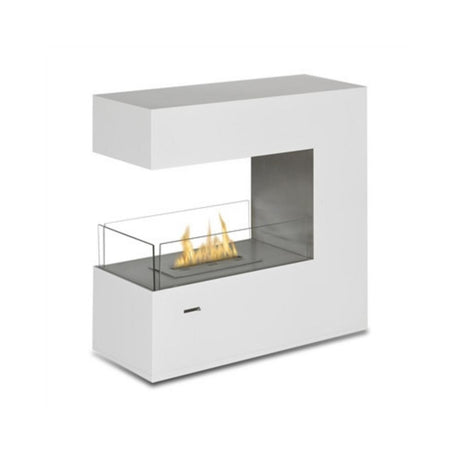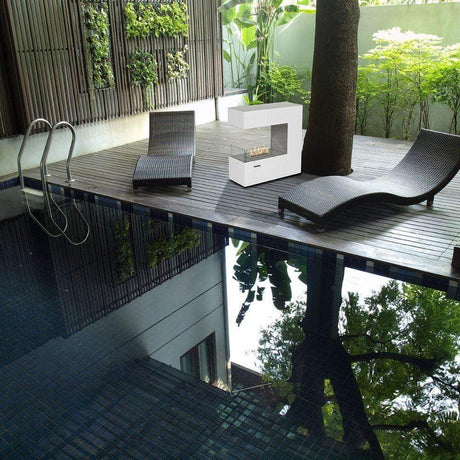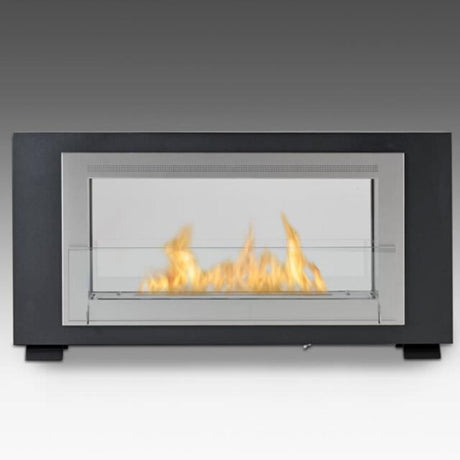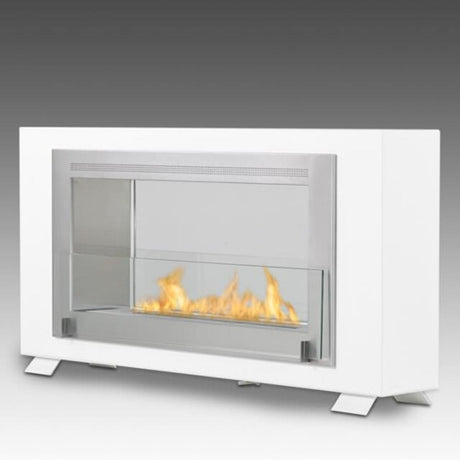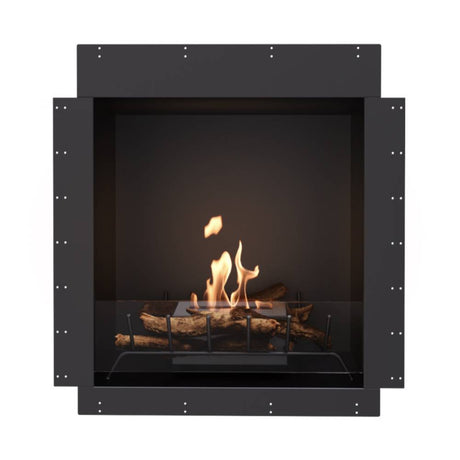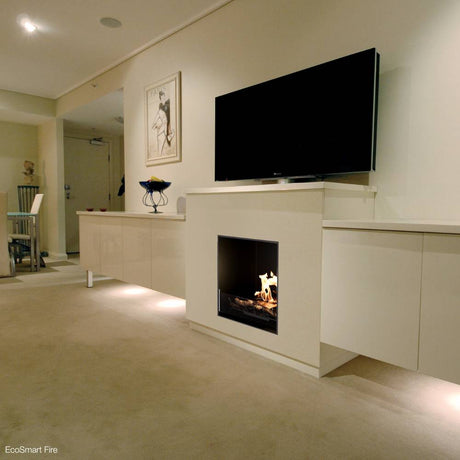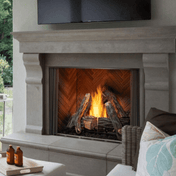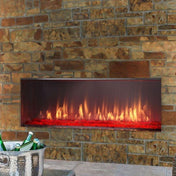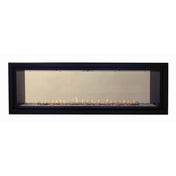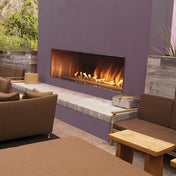

A real fire usually comes with a crew. A gas fireplace needs a gas line, and most models need a vent run through a wall or the roof. A wood fireplace needs a chimney. When a remodel budget gets tighter, those extra trades are hard to justify, and budgets are getting tighter: Houzz's 2026 survey of its users found the median planned renovation spend down by a quarter from the year before.
A built-in ethanol fireplace takes those trades out of the job. It burns bioethanol from a refillable tank, so there is no gas line, no flue and no electrical connection, and you light it by hand. What is left is the carpentry and finishing around it, and how much of that you need depends on which kind you choose. New to ethanol? Start with our complete guide to ethanol fireplaces.
Three Things to Know Before You Plan One
- No gas, no vent, no wiring. The fire runs on liquid fuel in a sealed burner and needs no utility connection of any kind.
- Not every format can touch wood. A zero-clearance firebox is the format that frames straight into wood studs. A grate or a loose burner needs non-combustible material around it, and a wall unit that recesses into the wall needs a lined cavity.
- It is a decorative fire with some heat. It gives off real heat, but it is not designed to be a home's main heat source, and you refill it by hand.
Four Ways to Build In an Ethanol Fire
Each format suits a different starting point, from an old fireplace you already have to a bare wall.
| Format | Where it goes | What has to surround it | Example |
|---|---|---|---|
| Ethanol grate | An existing wood-burning fireplace, with or without a working chimney | The masonry firebox you already have, on a non-combustible floor | EcoSmart Grate 30 |
| Ethanol burner | A fire feature you design: a niche, a hearth, a bench | A non-combustible box you build, with an air gap and a glass windscreen | EcoSmart XL Series |
| Zero-clearance firebox | A new wall framed in wood or metal studs | Ordinary framing, plus a 6-inch non-combustible panel above the opening | EcoSmart Heritage 56 |
| Fire pit kit | A table, bench or wall you build, indoors or out | Permanent construction cut to the kit's opening, with a safety tray indoors | EcoSmart Square 22 |
Ethanol Skips the Gas Line, the Flue and the Wiring
An ethanol fireplace needs no utility connection at all. EcoSmart's manuals put it plainly: the fires "do not require any form of permanent fixture or fitting, such as a flue for ventilation, a permanent connection or any kind of fixed utility for fuel supply." You fill the burner with fuel and light it with a long lighting rod.
That is the difference from every other real flame. Here is what each fuel asks of the house before it can burn:
| Gas | Electric | Wood | Ethanol | |
|---|---|---|---|---|
| Real flame | Yes | No | Yes | Yes |
| Gas line | Yes | No | No | No |
| Chimney or vent | Yes, unless it is a ventless model your local code allows | No | Yes | No |
| Electrical | Depends on the model | An outlet, or a hardwired circuit on larger units | No | No |
If you are weighing every fuel that works without a chimney, our chimney-free fireplace guide compares all five.
A Grate Puts Fire Back in an Unused Fireplace
An ethanol grate is the fastest way to a real flame, because the fireplace is already built. It is a burner set in a grate that you slide into the firebox, fill and light. EcoSmart's grates work with or without an operational chimney, so a flue that has been capped or has failed inspection does not rule one out.

A few things to settle first:
- Close the flue. It is not required, but an open chimney pulls the warmth straight up. EcoSmart recommends closing the damper or blocking the flue with a metal plate.
- Disconnect any gas. If the fireplace has a gas line, a licensed professional has to disconnect it and make it safe before the grate goes in.
- Check the space above. Inside a masonry firebox, the grate needs 23.6 inches of clearance overhead, and it has to sit on a non-combustible floor, which a masonry hearth already is.
Grates are rated for indoor use. In this episode of our show, we rank five ways to bring an old fireplace back, and the ethanol grate comes out as the quickest to set up.
A Burner Lets You Design the Fireplace Yourself
A burner is the fuel tank and flame on their own, and you build everything around them. It is the format for a fire in a stone niche, a long kitchen hearth or a custom media wall, because the shape is entirely yours.

The freedom comes with rules, and this is where a trade comes back into the job:
- The burner can never touch anything combustible. It has to sit in stainless steel, concrete, brick or natural stone.
- A custom box needs an air gap and a windscreen. EcoSmart specifies 0.8-inch spacers on every side, so the box never sits against combustible material, and a fixed glass windscreen 7 to 9 inches tall.
- The box has a minimum size. For the 36-inch XL burner it is 47.2 inches wide, 13.8 inches deep and 19.7 inches tall.
Building that box is usually work for a mason or a metal fabricator. EcoSmart also asks that drawings of a custom setting go to its representative for review before installation, which is worth doing early, while the design is still easy to change.
Zero-Clearance Fireboxes Frame Into Wood Studs
A zero-clearance firebox is a burner already sealed inside a box that carries its own clearances, so you can frame it into an ordinary wall the way you would a cabinet. This is the format that comes closest to the promise of a fireplace with no extra trades: a carpenter frames the opening, the box slides in, and the wall is finished around it.

The EcoSmart Heritage 56 is a good example of what the job involves:
- The opening: 60 inches wide, 23 inches deep and 45 inches tall, framed in wood studs. It can be fully recessed, partly recessed or mounted on the wall.
- The structure: the box is not load-bearing, so the framing above it has to carry itself, and the bottom of the box has to be fully supported.
- The finish: a non-combustible panel at least 6 inches tall above the opening. Fiber cement board, fire-rated drywall, stone, tile and steel all qualify.
- In the box: it ships with ceramic logs, a grate and a fire screen, so it reads as a traditional fireplace once it is lit.
Outdoors, a firebox has to sit under a protective overhang.
Not every built-in works this way. Wall-mounted ethanol fireplaces that can also be recessed, such as the Eco-Feu Brooklyn, follow different rules. Eco-Feu limits the recess to 6 inches so the controls stay within reach, and asks for an opening 5 inches larger than the unit on every side. The top, bottom, back and sides of that cavity have to be lined with a non-flammable board such as cement board. Read the manual for the exact model before you frame anything.
Fire Pit Kits Drop Into a Table You Build
A fire pit kit is a burner in a drop-in tray with a glass screen, made to be set into something permanent: a concrete table, a bench, a kitchen island. You build the structure to the kit's opening and lower the kit in.

The EcoSmart Square 22, for example, needs a 23.1-inch square opening, 9.8 inches deep, or 8.5 inches with the indoor tray. Two details catch people out:
- Indoors needs an extra part. The ethanol kit can go inside, but only with the Indoor Safety Tray installed, and EcoSmart asks for that to be specified when you order.
- The glass screen is not optional. The kit must not run without it.
The same kits are also sold with gas burners, which are rated for outdoor use only. If the table is going inside, ethanol is the version that can go with it. For finished tables that need no building at all, see our ethanol fire pits.
What You Still Pay For: Framing, Finish and Fuel
Ethanol removes the gas, venting and electrical work. It does not remove the carpentry, the finishing or the fuel, and a few rules still apply:
- Local approval may be required. EcoSmart notes that in some places approvals from building authorities are needed, and fuel storage has its own rules: in the US, a permit can be required to store more than 5 gallons indoors or 10 gallons outdoors. Check with your building department first, and see our article on ethanol fireplace regulations.
- Fuel is an ongoing cost. EcoSmart burners are made for e-NRG bioethanol only. The 36-inch XL burner holds about 2.4 gallons, and EcoSmart rates it at 8 to 13 hours on a fill.
- Refilling takes patience. Let the burner cool for 60 minutes after the flame goes out before you refill it. Filling a burner that is still lit or hot has caused severe burns, and our safety article covers why.
- There is no switch. These burners are lit by hand with the lighting rod. There is no wall switch or remote.
Expect Ambiance and Some Heat, Not a Furnace
A built-in ethanol fireplace gives off real warmth, but it is not designed to be a primary heat source. The 36-inch XL burner is rated at up to 15,000 BTU per hour.
Because the flame uses the room's air and there is no vent, room size matters. EcoSmart lists a minimum room of about 3,900 cubic feet for that 36-inch burner, roughly a 20 by 25 foot room with 8-foot ceilings. Wherever a room has less than 200 cubic feet for every 1,000 BTU per hour, keep a door open to the next room or a window open at least an inch, and never use one in a bathroom. Our room-size guide walks through the math.
Best for Remodels Without Gas or a Chimney
A built-in ethanol fireplace makes the most sense when:
- You want a real flame in a room where running a gas line or a vent is impractical or not allowed.
- You have an old fireplace nobody uses and want it working again without rebuilding the chimney.
- You are designing a feature, such as a niche, island or media wall, and want the fire to fit the design rather than the other way around.
It is the wrong choice if you want the fireplace to heat the house, want to turn it on from the couch, or would rather not handle liquid fuel. For those, look at electric fireplaces, which need only power and usually come with a remote, or ventless gas fireplaces where your local code allows them.
Tell Us Your Opening and We'll Match the Format
Send us a photo of the wall or fireplace with its measurements, and we will tell you which format fits and what it will take to build in. Call 866-713-2399 or email support@modernblaze.com.
Pin this article: