
A BTU is a unit of heat, and the number printed on a fireplace or patio heater tells you how much of it the appliance puts out every hour. Getting that number right is the difference between a room that finally feels warm and an appliance that looks good and does nothing.
Use the calculator below to size a space, then read on for what the number actually means and where the usual rules of thumb fall apart.
BTU Calculator
Sizes a fireplace or indoor heater for a single room. Enter the space you want to heat.
Roughly 2,344 watts if you are shopping electric.
What a BTU actually is
BTU stands for British Thermal Unit. One BTU is the amount of heat it takes to raise one pound of water by one degree Fahrenheit, which is about the energy released by a single kitchen match.
That is a quantity of energy, and on its own it tells you nothing about an appliance. What matters when you shop is BTU per hour, written BTU/h: the rate at which a unit delivers heat. Almost every manufacturer prints "BTU" on the spec sheet when they mean BTU/h. The two get used interchangeably in product listings, including ours, and the number is always the hourly rate.
The distinction matters for one practical reason. Watts are also a rate, so watts convert cleanly to BTU/h. They do not convert to BTUs, because those measure different things.
BTU to watts, and back
One watt is 3.412 BTU per hour. Every electric fireplace and electric patio heater we sell is rated in watts, and every gas appliance is rated in BTU/h, so this is the conversion you need to compare them.
BTU/h and Watt Converter
Type in either box.
Two conversions worth committing to memory, because they come up constantly:
| Watts | BTU per hour | Where you see it |
|---|---|---|
| 1,500 W | 5,118 BTU/h | The ceiling for anything that plugs into a standard household outlet |
| 3,000 W | 10,236 BTU/h | A hardwired 240V electric fireplace or a mid-size electric patio heater |
The 1,500 watt wall, and why most people hit it
This is the single most useful fact in this article. A standard 120V household circuit is 15 amps, and electrical code limits a continuously running appliance to 80 percent of that. That puts the continuous ceiling at 1,440 watts. Manufacturers settle on 1,500 watts, which draws 12.5 amps and is the most heat you can pull from a standard outlet without tripping anything.
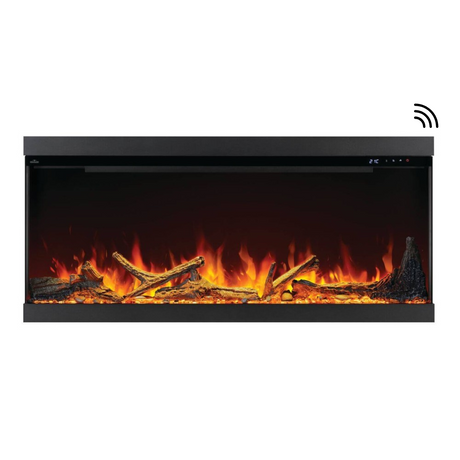
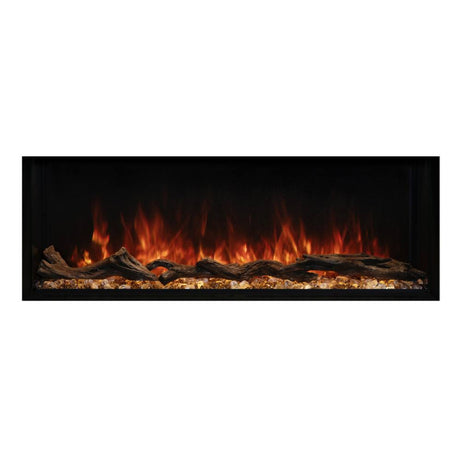
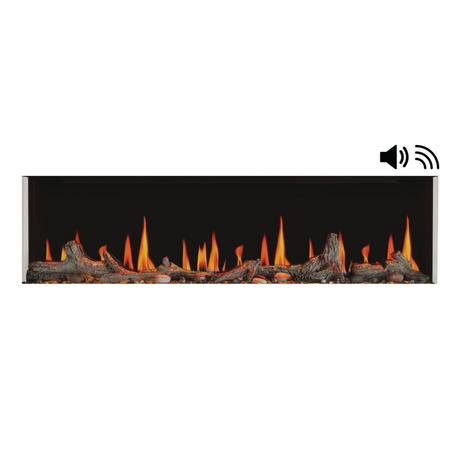
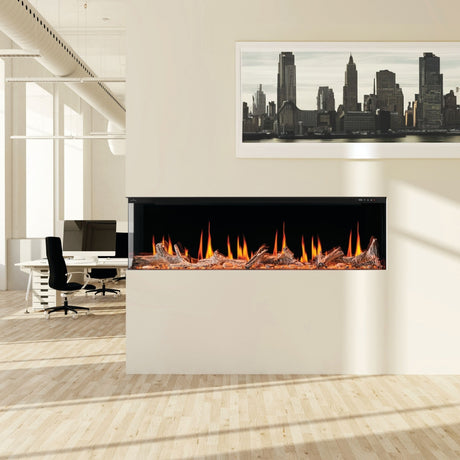
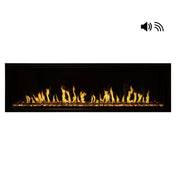
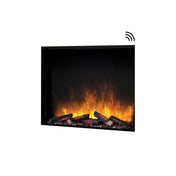
Convert it and you get about 5,100 BTU/h. That is the most heat any plug-in electric fireplace can produce, from the smallest insert to the widest linear model. A 100-inch electric fireplace and a 30-inch one put out identical heat, because they are both limited by the same outlet.
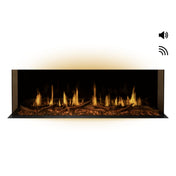
So the calculator above is really answering one question: does your room need more than 5,100 BTU/h? If it does, no plug-in unit will heat it, however impressive the listing looks. Your options at that point are a gas fireplace, or one of the electric fireplaces with powerful heaters that run on a dedicated 240V circuit and reach roughly twice the output.
BTU per square foot, and why the common formula misleads
The rule of thumb most sizing guides use is 20 BTU/h per square foot in a moderate climate with 8-foot ceilings. That is the baseline the calculator starts from, before it adjusts for your ceiling height, your climate, and how well the space holds heat.
| Room size | Moderate climate | Cold climate | Plug-in electric enough? |
|---|---|---|---|
| 150 sq. ft. | 3,000 BTU/h | 3,600 BTU/h | Yes |
| 250 sq. ft. | 5,000 BTU/h | 6,000 BTU/h | Only in a mild climate |
| 400 sq. ft. | 8,000 BTU/h | 9,600 BTU/h | No |
| 600 sq. ft. | 12,000 BTU/h | 14,400 BTU/h | No |
You will see manufacturers claim a 1,500 watt fireplace heats 400 square feet. Compare that against the table and the gap is obvious. That claim assumes a well-insulated room inside an already-heated house in a mild winter, with the fireplace topping up heat rather than supplying it. Under those conditions it is fair. As the only heat source in a cold room, it is not, and this is the most common reason a new electric fireplace disappoints.
Two other things bend the number, and the calculator accounts for both. Ceiling height is the one people forget: you heat volume, not floor area, so a vaulted 16-foot ceiling doubles the load of the same footprint. Insulation matters just as much, and an older home with single-pane windows can need a quarter more output than a new build of identical size.
One honest limit. Everything here sizes a supplemental appliance for one room. Sizing a system to heat a whole house is a different calculation, called a Manual J load calculation, and it belongs to an HVAC contractor who can measure your windows, walls, and air leakage. If you are replacing a furnace rather than adding a fireplace, that is the number to get.
What each type of fireplace actually delivers
These are the ranges across our own catalog rather than industry averages, so they reflect what you can actually buy.
| Type | Typical range | Most common |
|---|---|---|
| Gas fireplaces | 9,500 to 300,000 BTU/h | Around 38,000 BTU/h |
| Ethanol fireplaces | 4,000 to 20,400 BTU/h | Around 6,500 BTU/h |
| Electric fireplaces | Up to 10,200 BTU/h | About 5,100 BTU/h, the 1,500 watt standard |
| Water vapor fireplaces | Up to 8,200 BTU/h | Around 4,400 BTU/h |
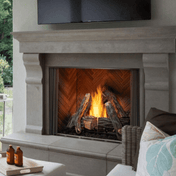
Gas is in a different class, and it is the only fuel that will heat a large room on its own. The trade-off is installation: a gas line, and on most models a vent, which the gas fireplace guide walks through. Ethanol sits in the middle on paper, but fuel burns fast enough that it is worth treating as ambience with some warmth attached rather than as a heat source. If that surprises you, what ethanol fireplaces actually are covers the fuel itself.
Electric and water vapor are the two you buy for the look. Both are ventless and both install almost anywhere, and both are honest supplemental heat rather than a heating system. Worth knowing before you shop: an electric fireplace warms a room with a fan-forced coil, which heats the air. That works well indoors and poorly outdoors, where warmed air simply drifts away. For choosing between models rather than sizing them, see the electric fireplace guide and the water vapor guide.
Patio heaters follow different rules
Outdoors, the square-footage math above stops applying, because there is no room to hold the heat. Most patio heaters are not trying to warm the air at all. They are infrared, which means they radiate heat that lands directly on people and surfaces and is absorbed there, the same way the sun feels warm on a cold clear day.
The open-flame models are the exception. Pyramid heaters, wicker flame towers and the decorative glass-tube designs send a large share of their output straight up as hot air. They are genuinely patio heaters and they look wonderful, but they behave more like a campfire than an overhead infrared unit, which is why they disappoint on a windy evening.
This is why an outdoor rating cannot be compared to an indoor one. A 20,000 BTU/h infrared patio heater and a 20,000 BTU/h fireplace do not feel remotely alike outdoors, because the heater never depended on the air in the first place and the fireplace does.
What to size on instead is coverage area and mounting height, both of which the manufacturer publishes. Across our catalog, electric patio heaters run from around 1,700 up to roughly 20,500 BTU/h, with 3,000 watts, or 10,236 BTU/h, being the most common size. Gas patio heaters run from 9,500 BTU/h up to 150,000 BTU/h on the commercial overhead models, with most sitting around 41,000.
The practical rule outdoors: heat the seating, not the yard. Aim coverage at where people actually sit, and for a larger patio use two or three smaller heaters spread across the space rather than one large one in a corner, which leaves cold seats at the edges. The patio heater buying guide goes through mounting, fuel and coverage in detail.
One more outdoor option that BTU numbers do not capture well: a fire pit guide. A fire pit is a gathering point rather than a way to warm a whole patio, and people arrange themselves around it, so its output matters far less than where you put it.
Sizing your space in three steps
- Measure the room and note the ceiling height. Length times width gives square footage.
- Run the calculator above, and be honest about insulation. If the room has old windows or sits over an unheated garage, pick poor.
- Match the number to a product. If it lands under about 5,100 BTU/h, any plug-in electric fireplace will do it. Above that, filter for heat output and look at gas or a 240V electric model.
If the number lands close to the line, size up rather than down. An appliance running at part load in a room that is warm enough costs little, while one running flat out in a room that never gets there costs the same and never satisfies.
Still unsure what your space needs? Talk to our team and we will size it with you.