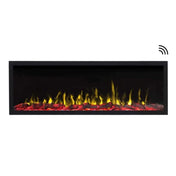

An outdoor fireplace is the one piece of a backyard that decides how late people stay. It gives a patio a focal point, a reason to arrange the seating a certain way, and enough warmth on a cool evening to keep everyone outside instead of drifting indoors.
Building one no longer means masonry and a chimney. A gas fireplace can be framed into a covered patio wall with no chimney at all. An electric unit rated for outdoor use can sit under a roof and run off a standard circuit. An ethanol fireplace needs no gas line, no flue and no permit, so it can go where a built-in never could. This guide walks the whole outdoor fireplace lineup, from a built-in gas firebox to a portable bowl you can carry to the deck.
Start With the Fuel, Because It Decides Everything Else
Fuel is the first decision, and it constrains the rest. It sets what you can install, where you can put it, how much heat you get, and how much work the installation becomes.
| Fuel | Best for | Real heat outdoors | What it needs |
|---|---|---|---|
| Gas | A permanent, built-in focal point on a patio or in an outdoor room | Yes, this is the category that genuinely warms a space | A gas line or a propane tank, and a framed opening |
| Electric | A covered patio, porch or three-season room where running gas is impractical | Limited, see the honest note below | A dedicated circuit and a roof over it |
| Ethanol | Anywhere with no gas line, no chimney and no permit path | Modest, a real flame with no flue | Nothing fixed, many models are freestanding |
| Gel | A tabletop accent, a balcony, a small deck | Ambience rather than heat | Nothing, it is fully portable |
Gas Outdoor Fireplaces: the Dedicated Build
Gas is what most people picture when they picture an outdoor fireplace, and it is the only fuel that reliably warms an open patio. Nearly every outdoor gas fireplace we carry is vent-free, which is the reason this category works outside at all: there is no chimney to build, so the firebox goes into a framed wall or a stone surround and vents nowhere.
Browse the whole category in outdoor gas fireplaces, or narrow by supply to natural gas or propane. Most models are sold for natural gas with a conversion kit available, so the tank-versus-line decision does not usually narrow your choice of unit.
The Traditional Outdoor Firebox

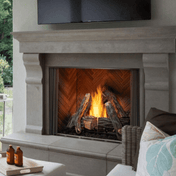
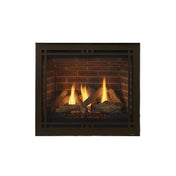
A rectangular firebox with a herringbone or stacked interior panel is the shape that reads as a real fireplace, and it is the one that anchors a seating group best. The Majestic Courtyard is the model we have sold more of than any other outdoor gas fireplace, and it is worth understanding why. It comes in two widths, takes an optional interior panel in traditional or herringbone brick, and accepts a hearth kit, a framed screen and a log set, so the same firebox can finish rustic or clean depending on what you put in it.
Step up in size and the Majestic Lanai gives you a wider opening with the same vent-free simplicity.
For a smaller patio or a tighter budget, the Majestic Vesper covers the same idea in a more compact firebox and is currently the fastest-moving outdoor gas fireplace we sell.
When the Fireplace Is the Architecture

Some outdoor fireplaces are meant to be seen as a finished object rather than framed into a wall. The Napoleon Galaxy is built around a full-width glass and stainless design that suits a modern build, and it takes a stainless cover so it can sit through the off-season.
The Empire Carol Rose range covers the same ground at several sizes, including a premium traditional firebox and a linear version for a contemporary elevation.
A Complete Fireplace That Needs No Wall

Everything above assumes you are building the fireplace into something. American Fyre Designs takes the opposite approach and casts the entire fireplace, firebox, chimney, hearth and all, as one freestanding piece. It arrives as a finished object, so there is no framing, no mason and no surround to design. You place it, connect the gas, and it is done.
The style is the appeal, and it is the one people are asking for right now. These are stucco outdoor fireplaces in the Spanish Colonial tradition: smooth stucco-textured concrete in sand and cream tones, a tall arched firebox opening, a molded cornice capping the chimney, and curved bench wings that flow out from the hearth so the fireplace and the seating read as a single sculpted piece. It is the look that carries a courtyard in Santa Fe or Scottsdale, and it lands just as well on a patio that has nothing else going on. They are cast in glass fiber reinforced concrete with a heavy textured finish, made in the USA, and offered in several neutral colors and hearth styles so the piece can be matched to stonework or decking.
The Cordova is the one to start with, and the Grand Phoenix is the statement version for a large terrace. Both are vent-free, and both are also sold in recessed-hearth versions if you would rather sink the base into a patio slab. More freestanding options, in every fuel, are in free standing outdoor fireplaces.
Use a See-Through to Divide the Patio Into Two Rooms

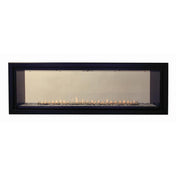
A see-through fireplace is the most useful trick in outdoor design, because it splits one large patio into two defined spaces without putting up a solid wall. You get separation and a sightline at the same time, and the fire earns its keep twice by facing both ways.
The pairings that work best put a working zone on one side and a relaxing one on the other:
- Outdoor kitchen on one side, seating on the other. Whoever is cooking stays part of the conversation instead of facing a wall, and the seating area gets a finished backdrop rather than a view of the grill.
- An outdoor living room split from the dining table, so eating and lounging feel like separate rooms even under one roof.
- Kitchen on one side, hot tub on the other. The fireplace screens the tub from the cooking and serving area, which is usually the thing people want most and plan for least.
- A spa area given its own enclosure, with the fire visible from the water and from the patio behind it.
The Majestic Lanai See-Through and the Napoleon Galaxy See Through are the two we specify most for this. For a linear version, the Empire Carol Rose See-Thru runs long and low, and the Superior Linear offers see-through as an option on the same body. More are collected in see-through fireplaces.
One thing to know before you frame the wall. Most outdoor see-through fireplaces are vent-free, which means they are open on both faces behind a mesh safety barrier rather than sealed behind glass. That is what lets them work without a flue, and it is also why they need the clearances in the manual respected on both sides. If you specifically want glass, you are looking at a direct vent unit, which is sealed and has to be vented to the outside.
Linear Gas, for a Modern Elevation

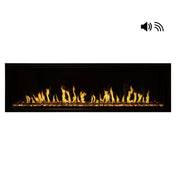
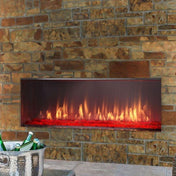
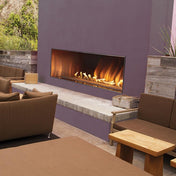
A linear fireplace is a long, low ribbon of flame rather than a square opening, and it is the shape that suits flat rooflines, stucco and board-formed concrete. Ours are collected in linear and modern outdoor gas fireplaces. The Carol Rose Linear and the Firegear Kalea Bay both run wide and shallow, and the Kalea Bay adds LED accent lighting behind the glass so it still reads as a feature when the burner is off.
Dropping Fire Into Something You Already Have

If there is already a masonry outdoor fireplace on the property, or a surround being built by a mason, you do not need a whole firebox. An insert or a burner drops into the opening and gives you gas convenience inside existing stonework. The outdoor fireplace inserts category covers this, including the Empire Carol Rose stainless inserts, and the Monessen Lumonessen burner is the simplest version of the idea.
For the look of a wood fire without the wood, outdoor gas logs sit on a burner inside an existing firebox. The Majestic Stadium Burner sets are a recent addition here and stack the logs on tiers so the flame rises through them rather than sitting behind.
Electric Outdoor Fireplaces: for the Covered Patio
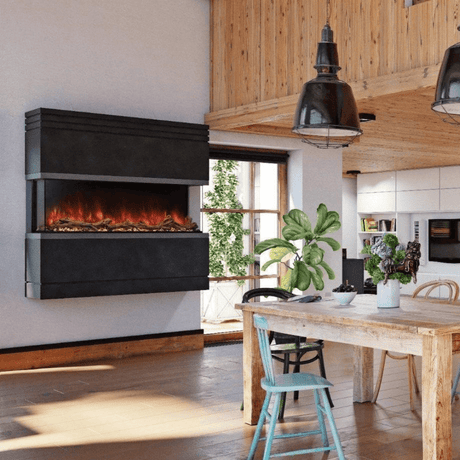
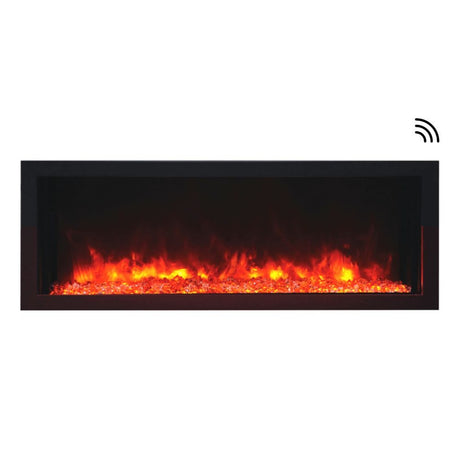
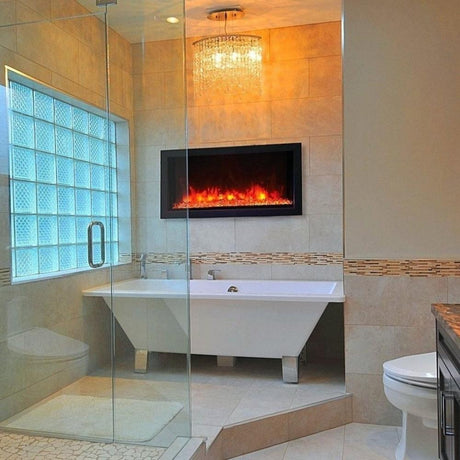
An outdoor-rated electric fireplace is the answer when running a gas line is impractical, when the space is a porch or three-season room, or when you want the fireplace on a wall that has power and nothing else. Everything in outdoor electric fireplaces is rated for exterior use.

One honest thing first, because it changes what you should expect. An electric fireplace heats with a fan-forced coil, which warms the air. A patio heater uses infrared, which warms people and objects directly. Outdoors, warmed air simply drifts away, so an outdoor electric fireplace is bought for the look and the atmosphere rather than for warmth. If you want people to actually feel heat on an open patio, that job belongs to gas or to overhead patio heaters, which mount above the seating and warm people directly. There is more on pairing the two at the end of this guide.
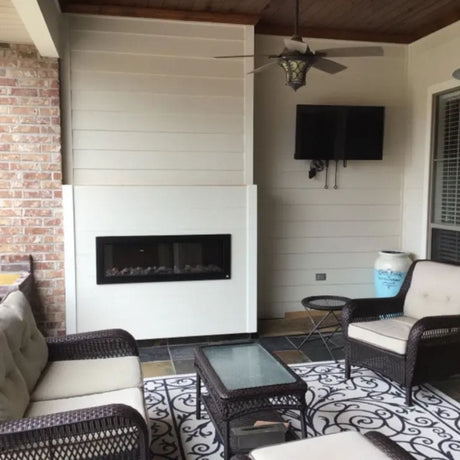
Two other things are true of every outdoor electric fireplace. It has to live under a roof, protected from direct rain and direct sun, and it needs its own circuit. Beyond that, installation is far simpler than gas.
Built for Outdoors From the Start
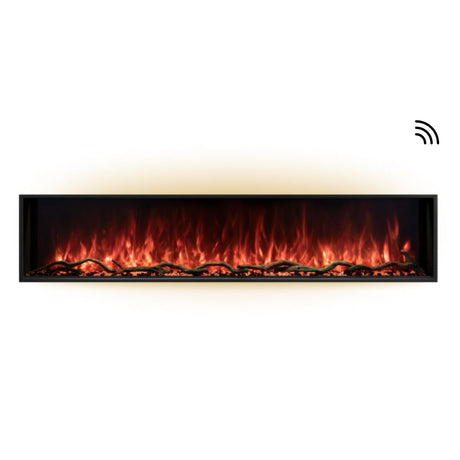
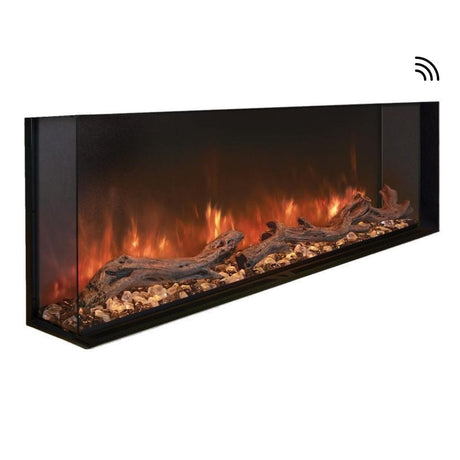
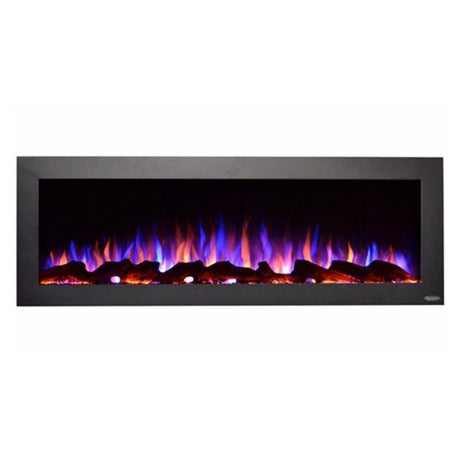
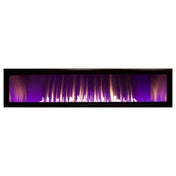
The Modern Flames Landscape Pro Slim is the model we point most people to first. Modern Flames publishes a dedicated outdoor rating and a set of outdoor installation requirements for it, it comes in a wide range of widths, and it is a clean linear face that suits a covered patio without looking like an indoor fireplace that wandered outside. The Landscape Pro Multi is the same platform in a three-sided form, which is the one to use when the fireplace sits at the end of a peninsula or in a half-wall between two zones.
The Dimplex Ignite Evolve is the other one worth knowing about, and it is certified for covered outdoor installation across its full range of widths. It recesses fully into a 2x6 wall for an edge-to-edge look, and the flame color, brightness and speed are all adjustable, with optional crackling audio. Dimplex is unusually direct about the trade-off: the same unit carries a five-year warranty indoors and a one-year warranty outdoors. That is worth factoring in, and it is a useful reminder that "outdoor rated" means built to survive a covered patio, not built to be ignored out there.
The Realistic Option, With a Condition Worth Reading
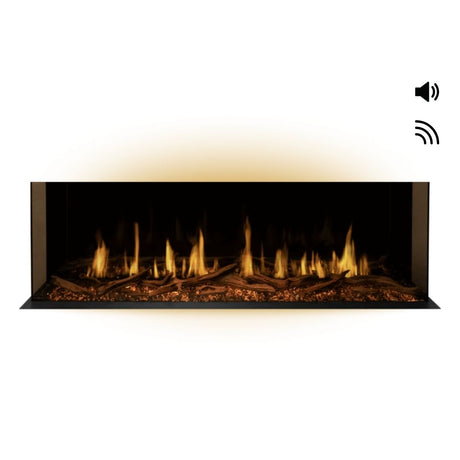
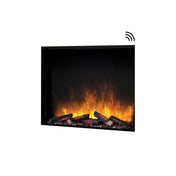
The Modern Flames Orion V2 series uses a recorded fire played on a display rather than a synthesized light effect, and the difference in realism is obvious in person. Version 2 is the outdoor-rated one, and within it the Orion Multi is the three-sided model and the Orion Slim is the single-sided one for a 2x6 wall.
The condition matters here, so it is worth stating plainly: only the built-in installation is approved outdoors. Wall mounting is not, the unit has to sit under a patio cover away from direct water and direct sun, and the roof overhang needs to be at least half the height measured from the bottom of the fireplace. An uncovered deck or a pergola with open slats does not qualify.
Three-Sided and Slim Formats

If the fireplace is going into a partition wall, a column, or the end of a peninsula, a multi-sided unit shows flame from more than one direction. The Amantii TRU-VIEW XT is the widest of these, and the SimpliFire Triton is the most recent three-sided built-in we have added, with a linking kit if you want to run two of them in a line.
For a tight wall, depth is the constraint rather than width. The Orion Slim and the Landscape Pro Slim are both built for a standard 2x6 wall, which is what makes them practical in a partition that also has to carry framing and wiring, and the Ignite Evolve recesses fully into the same depth.
Ethanol and Gel: No Gas Line, No Chimney, No Permit
Ethanol fireplaces burn a clean liquid fuel with a real flame and no flue, which means they can go somewhere with no infrastructure at all. That is the whole appeal: a real fire on a balcony, a courtyard, a rented patio, or a wall where running gas was never an option. Browse them in outdoor ethanol fireplaces.
Freestanding Sculptural Pieces

The Le Feu Dome is the newest brand in this guide and the least conventional thing in it: a spherical steel fireplace that comes on low legs, tall legs, a floor pole, or suspended from the ceiling. It is a genuine sculpture that happens to hold fire, and because it is freestanding it can be moved and brought under cover when it is not in use.
The Eco-Feu Vision series takes the opposite approach. It is a linear burner running between two glass walls, so the flame sits in a clear panel and is visible from both sides, and it stands on the floor without touching a wall. That makes it useful in the middle of a space rather than against the edge of one, and it comes in several lengths. Both live in free standing outdoor fireplaces along with the rest of the models that need no wall.
Built Into a Wall Without a Flue

Ethanol also works as a built-in. The Eco-Feu Santa Lucia is a wide linear unit that mounts on a wall or recesses into it, and the Eco-Feu Paramount gives you a three-sided view without any of the venting a gas equivalent would need.
Fire on a Table
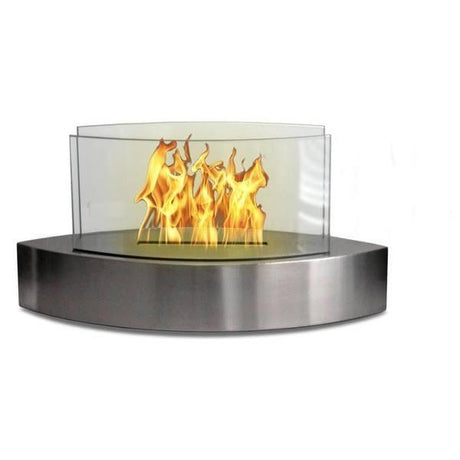
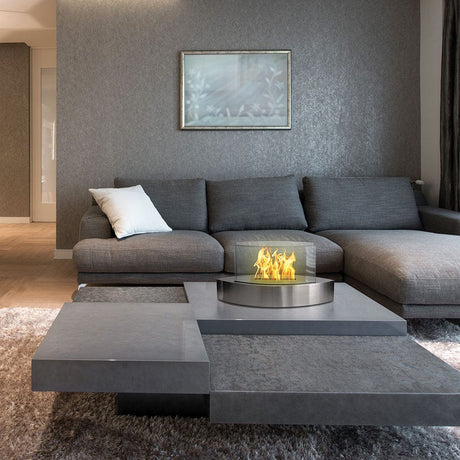
At the smallest end, a tabletop unit puts a flame in the middle of a dining table or on a side table next to the seating. The Anywhere Fireplace Lexington is the simplest version, and the outdoor gel fireplaces do the same job with canned gel fuel, which needs no pouring and no filling.
The concrete bowls from EcoSmart Fire sit between the two ideas, a wide open flame in a cast bowl that works as a low centerpiece on a patio.
When the Fire Should Stand Up, Not Sit In a Wall

A fire tower is a tall vertical column of flame, and it solves a problem a fireplace cannot: it throws light and movement at standing height, which is what you want along a walkway, at the corners of a terrace, or flanking an entry. Ours are in outdoor fire towers, in copper and corten steel as well as powder-coated finishes, and they are usually specified in pairs.
Finishing the Look: Surrounds and Mantels Rated for Outside
A mantel is what turns a firebox into a fireplace, and outdoors the material has to survive weather. That rules out most interior mantels, which is why outdoor fireplace mantels is a separate category rather than a filter. There are two different things in it, and they solve different problems.
A Shelf, When the Wall Is Already Finished
If the fireplace is going into stone or stucco that will look finished on its own, a shelf is all you need. Lexington Hearth makes most of what we sell here, in cast concrete finished to look like sawn timber or reclaimed beam, so you get the warmth of wood grain in a material that does not check, swell or rot on an exterior wall.
A Full Surround, When You Want the Stone Look Without the Mason
The other option wraps the whole opening. Cascadia Hearth & Stone builds wall-installed surrounds in natural stone, with French and traditional architectural profiles, and Omega does the same in cast stone, in three-piece and picture-frame designs. Cast stone is the lighter of the two, which matters on a wall that was not built to carry masonry.
Either way you get the elevated stone look without commissioning stonework, and the effect on a plain patio wall is out of proportion to the effort. One practical note: both are sold as the surround only, around a fireplace opening you choose separately, so confirm the opening size, its height above the floor, and the clearances your firebox requires before ordering.
Extending the Setup Beyond the Fireplace
Most people who build an outdoor room do not stop at one fire feature, and the three that pair with a fireplace each do something it cannot.
A Fire Table for the Middle of the Seating

A fire table sits closer to a fire pit than to a fireplace. Where a fireplace is a wall you face, a table is a centerpiece people sit around, and it doubles as a surface for drinks. The outdoor fire pit tables range runs from compact square models up to dining and bar height. Pairing one with a fireplace gives a patio two zones, a focal wall at one end and a gathering point in the middle.
Torches for Height and Edges

Gas torches mark boundaries and add flame at eye level without taking floor space. They work along a pool edge, at the top of steps, or at the corners of a pergola, and they read as landscape lighting that happens to be fire.
Heaters, Which Are the Part Most People Skip

This is the honest addition to any outdoor fireplace plan. A fireplace radiates forward, so the two or three chairs directly facing it are comfortable and the rest of the group is not. On a large patio, or on any patio in a breeze, that difference is the reason people go inside.
Overhead outdoor electric heaters solve it because they use infrared, which warms people directly instead of warming air that blows away. Mounted over the seating group or on the underside of a patio roof, they cover the chairs the fireplace cannot reach, and they take nothing off the floor. A fireplace as the focal point plus heaters over the seating is the combination that actually keeps people outside after dark.
How to Choose, in Four Questions
If you are still deciding, these four settle most of it.
- Is there a roof over it? No roof means gas or ethanol. Every outdoor-rated electric fireplace needs cover.
- Do you want it to actually heat people? If yes, gas, and plan for heaters as well on a large patio.
- Is there a gas line, or can there be? If not, ethanol gives you a real flame with no infrastructure, and electric gives you the look with a standard circuit.
- Is it built in or moved around? A built-in needs framing and a finished surround. Freestanding and tabletop models need nothing and can go inside for winter.
If you would rather talk it through than narrow it down alone, start from the full outdoor fireplaces collection and reach out with the space you are working with. We will tell you what fits and, just as usefully, what does not.