

A built-in electric fireplace recesses into a framed wall opening so the glass finishes flush with the wall, which makes it a natural fit for a renovation or a new build. There is no chimney, vent or gas line, so the work comes down to framing the opening, getting power to it and finishing the wall. This guide walks through the materials, wall depth, power options, clearances and the six install steps. If you are still choosing a model, start with our built-in electric fireplaces.
Can You Install a Built-in Electric Fireplace Yourself?
Yes, if you are comfortable framing a stud wall. The carpentry is straightforward. The electrical side depends on the model: a cord-and-plug fireplace needs an outlet inside the framing, while a hardwired model, or any 240V installation, is a job for a licensed electrician. Your local code decides whether an outlet inside the opening is allowed, so check before you frame.
What You Need
1. Building materials: lumber for framing, a header for the top of the opening, drywall or another wall finish, and screws.
2. Tools: Phillips screwdriver, drill, saw, level, measuring tape, stud finder, pliers and gloves.
3. The installation manual for your model. Every fireplace we sell ships with one, and most are posted as a PDF on the product page. The rough opening, depth and clearances all come from it.
Wall Depth
Check the depth your model needs before the wall goes up, because it decides how you frame. A 2x4 stud wall gives about 4 inches including the drywall, and a 2x6 wall about 6 inches. Some fireplaces fit those standard walls, and many need a deeper build-out.
Fits a 2x4 Wall
Slim slide-in models such as the Modern Flames Spectrum Slimline and the SimpliFire Allusion Slim need only a 4-inch finished opening. Others sit partly recessed in a 2x4 wall with the front standing proud and a spacer or trim kit closing the gap, such as the Touchstone Sideline Elite Pro with its spacer kit, or the Dimplex IgniteXL with its trim kit and the Dimplex Ignite Evolve. See our fireplaces for 2x4 walls.
Fits a 2x6 Wall
Many popular linear models are made for a 2x6 wall, including the Touchstone Sideline (5-3/4 inch rough opening), the Modern Flames Landscape Pro Slim and the Orion Slim.
Needs a Deeper Build-Out
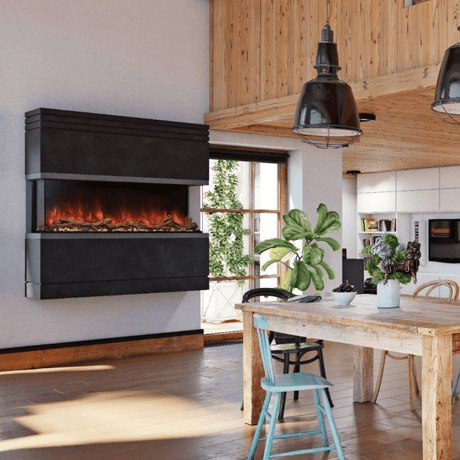
Many fireplaces need more depth than any standard wall gives, so you frame a bump-out or chase forward from the wall. That is where you find many of the most realistic models: 3-sided and bay fireplaces, virtual fireplaces such as the Modern Flames Orion range, and traditionally shaped fireboxes. A few examples from their manuals: Orion Multi 9 inches, Modern Flames Redstone 10 inches, Orion Traditional 10-1/2 inches, Dimplex Ignite XL Bold 11-5/8 inches, SimpliFire Triton almost 13 inches.
Types of Recessed Installation
Built-in electric fireplaces go into the wall in a few different ways. The big difference is when the fireplace goes in: during framing, before the drywall, or after the wall is finished. The install type also decides how the edge looks. Check which method your model's manual covers before you frame.

Fully Recessed, Frameless
The fireplace is set into the framing before the drywall goes up, and the wall finish runs right to the edge of the glass, with no trim around it. This gives the cleanest look, but you have to plan it during construction. The Modern Flames Orion Multi (manual) and the Landscape Pro Slim (manual) both use drywall stops on the fireplace to finish the wall flush.
Slide-In With Trim
The wall is framed and finished first, then the fireplace slides into the opening and a trim frame covers the cut edge of the drywall. It is the most forgiving option, and the right one if the wall is already done. The Touchstone Sideline (manual) and Sideline Elite (manual) install this way. The Modern Flames Spectrum Slimline (manual) does too, and needs only 4 inches of depth.
Either Way: Frameless or Slide-In
Some models give you the choice. The second-generation Modern Flames Orion Slim ships with a slide-in frame for a finished wall, or you can swap in its built-in frame and set it into the framing for a frameless look (V2 manual). The Orion Traditional V2 works the same way (V2 manual).
Partial Recess in a 2x4 Wall
If the fireplace is deeper than a 2x4 wall, it can sit partly recessed with the front standing proud of the wall, and a spacer or trim kit closes the gap around the edge. The Touchstone Sideline Elite Pro does this with its spacer kit (manual), and the Dimplex Ignite Evolve installs partially recessed in a 2x4 frame or flush in a 2x6 frame (manual).
See-Through
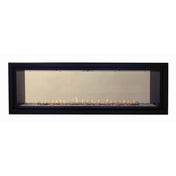
A see-through fireplace spans the full depth of a wall between two rooms, with glass on both faces, so you frame the opening through the wall rather than into it. Examples are the Napoleon CLEARion Elite (manual) and the Modern Flames Nova Clear (manual).
Bay (3-Sided)
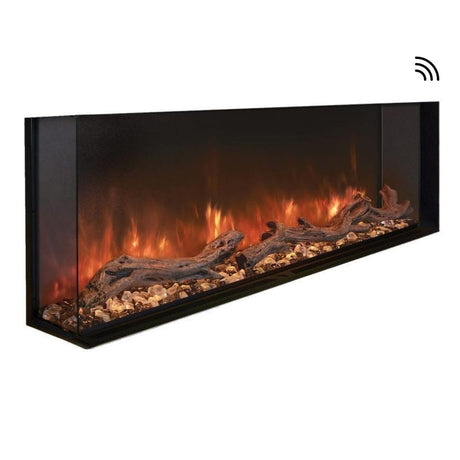
A bay fireplace shows flame through the front and both ends, so it sits forward of the wall in a framed surround that leaves the ends open. Many can also be closed in on one or both ends with panels, for a corner or front-only look. The Orion Multi installs as a bay or a 2-sided corner. The Dimplex Ignite XL Bold (manual) and SimpliFire Triton (manual) convert the same way. See all 3-sided electric fireplaces.
Open Corner
An open corner fireplace shows flame through the front and one end. The other end is closed with a panel and finished into the wall, so it suits the end of a wall or a corner of the room. On the models below, you choose which end stays open when you install it. The Orion Multi installs with the right or left end exposed, the Amantii TRU-VIEW XL has separate steps for front and right side or front and left side viewing (manual), and the Dimplex Ignite XL Bold uses the same framing for front, corner and bay installs.
Power: Plug-In, Hardwired or 240V
Many built-in models ship with a cord and can be plugged in or hardwired. Some are hardwire only, and the product page and manual say which. Models that offer 240V must be hardwired for it, and in return they give up to about twice the heat of the same fireplace on 120V. On a standard 120V circuit most heated models draw about 1,500 watts, close to 5,000 BTU, which is supplemental heat for roughly 400 to 500 square feet; on 240V that rises to up to about 1,000 square feet.
Clearance Requirements
Keep furniture, curtains, bedding and other combustible materials at least 3 feet from the front of the fireplace.
Most built-in electric fireplaces are rated for zero clearance at the sides, back and bottom, so wood studs and drywall can run right up to the unit. The top is different. Most models set a minimum distance from the top of the fireplace to a mantel, shelf, TV or ceiling, a few need a gap between the top of the unit and any insulation, and the heater outlet must never be covered. The numbers vary by model, from a few inches to two feet, so take them from your manual.
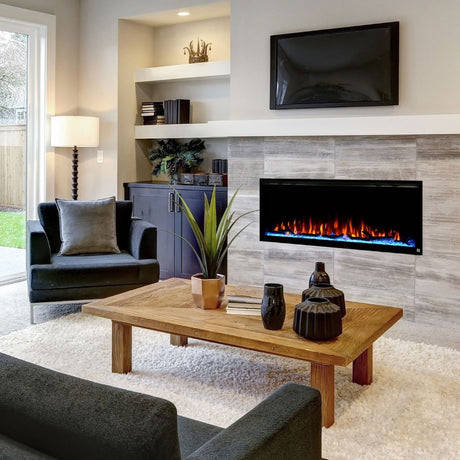
Planning a TV above the fireplace? Keep the distance your manual gives to the TV, and choose a fireplace at least as wide as the TV so the wall looks balanced.
Installation Steps
If your model has a cord, plug it in and test the flame, lights and heat before it goes into the wall. A hardwire-only model gets tested once it is wired.
1. Frame the Opening
Build the opening to the rough opening size in your manual. It is usually a little larger than the fireplace itself, often about a quarter inch, so the unit slides in and can be leveled. The fireplace is not load-bearing, so frame a header across the top. Plain wood studs and drywall are fine.
2. Bring Power to the Opening
For a cord-and-plug model, an electrician installs an outlet inside the framing where your manual shows it, if your local code allows it there. For a hardwired model, or any 240V installation, the electrician runs the circuit into the opening and makes the connection at the fireplace's wiring box. Many owners hardwire a plug-in model anyway for a clean install.
3. Set the Fireplace in the Opening
This is usually a two-person step. Lift the fireplace into the opening and level it.
4. Secure It to the Studs
Drive the mounting screws through the brackets or holes on the top and sides of the unit into the wall studs, then finish the wall around it.
5. Add the Decorative Media
Your fireplace comes with logs, fire glass or another decorative media. It goes in after the fireplace is secured in the wall, and you can change it later without touching the installation.
6. Install the Front Glass
The front glass goes on last and gives the fireplace its finished look.
Video: Installing a Touchstone Sideline Recessed Electric Fireplace
This 5-minute video shows the whole process, from preparing the wall to turning on the fireplace, on a Touchstone Sideline 50. Details differ between brands, but the sequence is the same.
This guide is for general information. Your model's installation manual is the instruction to follow.
Every fireplace we sell ships with an installation manual, and most are posted as a PDF on the product page. Follow the one for your model.
Questions about a specific model? Contact us and we will check the manual with you.
Further Reading
- How to install a wall-mounted electric fireplace
- How to install an electric fireplace insert, if you are filling an existing fireplace opening
- Electric fireplace buying guide







1 comment
I purchased an electric fireplace, I would like it recessed on an exterior wall, since there is insulation inside the wall is it safe to use an exterior wall for placement?